Claude Fable 5 is not just a better model
A practical guide for small AI-native teams on Claude Fable 5, Claude Mythos 5, model routing, permission boundaries, long-running pipelines, fallback behavior, cost, and human review.
The real upgrade is not the model. It is the operating system around it.
Anthropic introduced Claude Fable 5 and Claude Mythos 5 on June 9, 2026. Fable 5 is positioned as Anthropic’s strongest broadly available model, built for demanding reasoning and long-horizon agentic work. Mythos 5 shares the same capability foundation, but is made available through Project Glasswing for approved security-focused customers such as cyberdefenders and infrastructure providers.
For small AI-native teams, the obvious reaction is to ask: should we switch?
That is the wrong first question.
A better question is: if the model can hold more context, reason through longer tasks, produce longer outputs, inspect visual material, and participate in more complex workflows, is your team ready to use that capability safely?
If not, a stronger model does not automatically make the team better. It can make existing chaos larger. More context can become a dumping ground. Better reasoning can make people skip review. Longer outputs can create more material than anyone checks. Longer-running agent work can hide mistakes until much later in the process.
Claude Fable 5 should not be treated as a smarter chat window. It should be treated as a reason to redesign the system around your AI work.
What changed with Claude Fable 5?
The most important thing about Fable 5 is not that it is “new.” It is where Anthropic places it in the model stack.
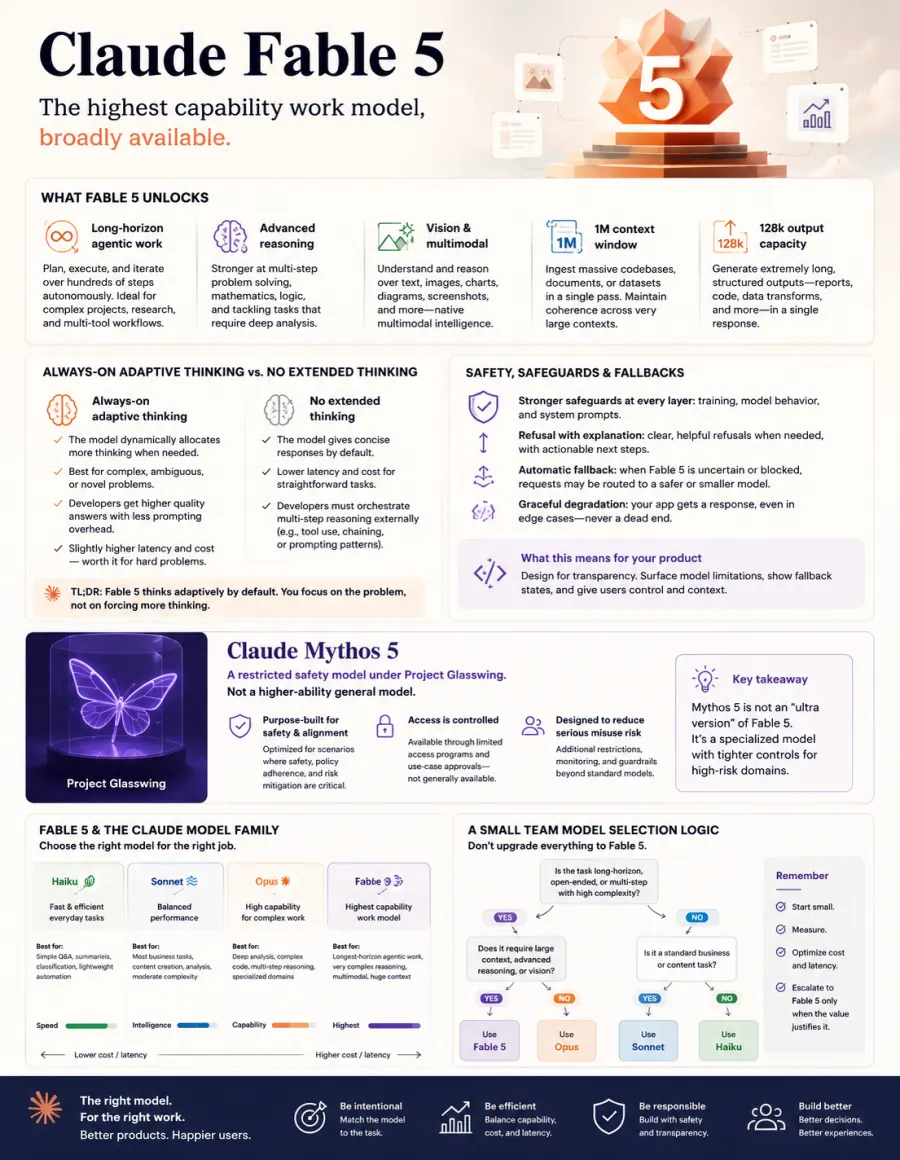
Fable 5 is the broadly available model for the hardest general-purpose work: demanding reasoning, long-horizon agentic tasks, large-context analysis, software engineering, visual understanding, scientific and technical work, and long-form generation.
Several details matter for small teams.
First, Fable 5 is designed for longer tasks, not only better answers. That matters because many real business workflows are not one-turn questions. They involve messy inputs, conflicting constraints, partial information, multiple drafts, review checkpoints, and handoff into a final deliverable.
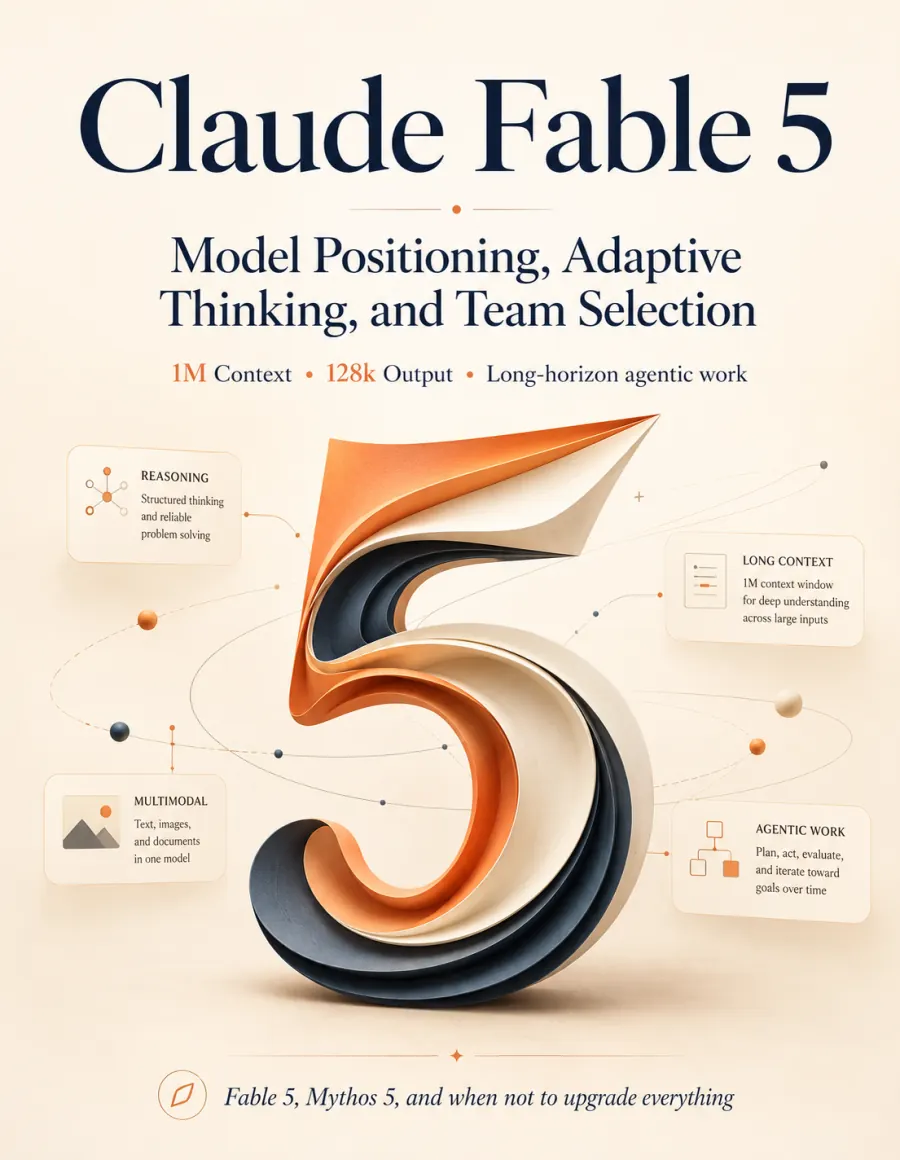
Second, Fable 5 and Mythos 5 support a 1M token context window by default, with output up to 128k tokens. This changes what is possible. A team can put more of a project into one working context: customer notes, product specs, code excerpts, screenshots, meeting notes, research links, decision history, and constraints.
But large context is not the same as good context. If the material has no source labels, no dates, no priority, and no sensitivity levels, then a 1M token window simply becomes a larger junk drawer.
Third, Fable 5 is more expensive than many everyday model choices. Anthropic’s pricing page lists Fable 5 and Mythos 5 at $10 per million input tokens and $50 per million output tokens. Opus 4.8 is listed at $5 per million input tokens and $25 per million output tokens. That does not make Fable 5 “too expensive.” It means it should be reserved for work where the output has high value, high reuse, or high decision impact.
Fourth, Fable 5 introduces product behavior that developers need to design for. Anthropic documents refusal behavior and fallback behavior. If a request is refused, the Messages API can return HTTP 200 with stop_reason: "refusal". That means a technically successful API response may still represent an incomplete business task.
For product teams, this distinction matters. A refusal is not the same as a network error. It needs its own UX, logging, and fallback policy.
Fable 5 is a work model, not a content toy
The easiest way to waste Fable 5 is to use it for everything.
A short summary does not need a frontier model. A headline rewrite does not need a 1M token context window. A format conversion job should not pay for the most capable reasoning model available.
A small team should place Fable 5 where it can create leverage.
Good candidates include:
- turning a set of customer interviews, project notes, and product constraints into a roadmap;
- reviewing a large codebase and producing a migration plan;
- combining screenshots, docs, and business goals into a product critique;
- analyzing a long research corpus and producing a structured report;
- planning a multi-step agent workflow with risks, checkpoints, and handoffs;
- drafting a high-stakes client proposal that must reflect many details;
- auditing a system design where cost, security, UX, and maintainability all matter.
These are not “write me a paragraph” tasks. They are work-system tasks. They require context, judgment, structure, and review.
That is where Fable 5 makes sense.
What “always-on adaptive thinking” means in practice
Anthropic describes Fable 5 and Mythos 5 as using always-on adaptive thinking, and notes that they do not support extended thinking.
For teams building with these models, the practical takeaway is simple: do not design your system around a visible “deep thinking” switch. The model adapts its reasoning behavior internally based on the task.
That changes how you should evaluate it.
You cannot only compare one impressive answer. You need to test the model on the work that matters to your team:
- Does it preserve constraints across a long task?
- Does it cite or respect the right source material?
- Does it notice when information is missing?
- Does it separate facts from assumptions?
- Does it keep track of decisions made earlier in the process?
- Does it produce output that a human can review efficiently?
Adaptive reasoning is useful only if it survives contact with your real workflow. Public demos and benchmark charts are not enough.
Mythos 5 is a governance signal
Claude Mythos 5 is not simply the “premium” version of Fable 5.
The important difference is availability and use case. Mythos 5 is made available through Project Glasswing for approved cyberdefenders and infrastructure providers. In other words, Anthropic is treating the highest-sensitivity security use cases differently from broadly available general-purpose work.
Most small teams will not use Mythos 5 directly. But they should pay attention to the product logic behind it.
As model capability increases, permission boundaries become more important.
A small team can apply the same principle internally:
- not every teammate should be able to run the highest-permission agent;
- not every model should access customer data;
- not every workflow should connect to production systems;
- not every output should be publishable without review;
- not every fallback should be allowed to continue a high-risk action.
This is not enterprise bureaucracy. It is basic operational hygiene.
The smaller the team, the more tempting it is to use shared accounts, copy raw data into chats, and let AI tools operate without clear boundaries. Mythos 5 is a reminder that capability and governance are part of the same conversation.
Refusals and fallback should be designed, not patched later
Fable 5 includes more conservative safeguards for broad availability. Anthropic also notes that some requests may fall back to Claude Opus 4.8, with fallback affecting less than 5% of sessions on average.
This is not just a technical footnote. It affects product behavior.
If your app treats every HTTP 200 as success, you may mark a task complete even when the model refused it. If your system silently falls back to another model, you may lose track of which model produced the final output. If a high-risk workflow continues after fallback without human review, you may bypass the very boundary that was supposed to keep the workflow safe.
A better design has three layers.
First, distinguish technical errors from model refusals. A refusal should be logged and shown differently from a timeout or invalid request.
Second, define fallback permissions. A fallback model can continue low-risk drafting or summarization. It should not automatically continue actions such as sending email, publishing content, editing production data, or touching customer records.
Third, keep an audit trail. For each important task, record the model requested, model used, refusal state, fallback state, input source, output version, and human approval status.
Small teams do not need a complex governance platform. They do need enough logging to answer: what happened, why, and who approved the final action?
The right model stack for a small team
Fable 5 does not make every other model obsolete. It makes model routing more important.
A practical small-team stack might look like this.
Use lighter models for low-risk, high-volume work:
- tagging;
- formatting;
- short summaries;
- simple translation;
- support reply drafts;
- routine content variations.
Use mid-tier or previous high-capability models for everyday professional work:
- meeting-note structuring;
- product requirement drafts;
- code review suggestions;
- internal documentation;
- ordinary research;
- first drafts of articles or proposals.
Use Fable 5 for work that is complex, expensive to redo, or likely to become an asset:
- strategic research;
- large-context synthesis;
- codebase migration planning;
- long-running agent pipelines;
- important client deliverables;
- multi-document policy or system reviews;
- content assets that will be reused across the website, sales, onboarding, or internal operations.
The rule is not “always use the best model.”
The rule is: use the strongest model where it changes the quality of the decision or the durability of the asset.
Fable 5 is best used inside a long-task pipeline
The model’s value increases when the workflow is staged.
A useful long-task pipeline has six parts.
- Input preparation
Label sources, dates, owners, sensitivity, and priority. Do not throw raw material into the model and hope it sorts everything out.
- Planning
Ask the model to produce a plan, assumptions, missing information, risks, and checkpoints before generating the final answer.
- Execution
Break the task into stages. Each stage should have a clear output and a review point.
- Verification
Check factual claims, prices, dates, citations, technical details, and legal or customer-facing statements against source material.
- Human approval
Any external action should require a person: sending, publishing, merging, deleting, pricing, billing, or committing to a customer.
- Archiving
Save the prompt, inputs, output version, human edits, and final decision. This turns a one-off model run into a reusable asset.
This is how small teams turn model capability into operating leverage.
A checklist before adopting Fable 5
Before making Fable 5 the default model for serious work, answer these questions.
- Which tasks actually need a 1M token context window?
- Which outputs will be reused or affect business decisions?
- Which tasks should stay on cheaper models?
- What data is allowed into the model?
- Which actions require human approval?
- How will the product handle refusal?
- What happens if the request falls back to another model?
- Do you log model requested, model used, source material, output version, and approval state?
- Have you measured token cost for long-context tasks?
- Do you know the model lifecycle and deprecation policy for the models you depend on?
If these questions feel heavy, that is the point. Fable 5 is powerful enough that small teams should treat model adoption as an operating decision, not a casual settings change.
Conclusion: do not chase the model. Upgrade the system.
Claude Fable 5 pushes broadly available AI further into serious work: large context, long outputs, demanding reasoning, visual understanding, software engineering, and agentic tasks.
Claude Mythos 5 points in a different but equally important direction: the more capable the model, the more carefully access and use cases need to be governed.
For small AI-native teams, the best response is not to replace every workflow overnight. The best response is to build a stronger AI work system: task routing, permission boundaries, fallback design, cost control, human approval, logging, and review.
Models will keep improving. The durable advantage is not knowing every model announcement first.
The durable advantage is being able to turn model capability into reliable work.
Risks and limitations
- This article is based on Anthropic’s public documentation as checked on June 10, 2026. Model availability, pricing, behavior, and platform support may change.
- Claude Mythos 5 is not broadly available. Most small teams should not plan around direct access to it.
- Fable 5’s long context and long output capabilities can increase cost quickly if used indiscriminately.
- This article is not legal, security, or compliance advice. Teams handling sensitive customer data or production systems should define their own review and approval process.
Official sources
- Anthropic Claude API Docs: Introducing Claude Fable 5 and Claude Mythos 5
- Anthropic Claude API Docs: Models overview
- Anthropic Claude API Docs: Pricing
- Anthropic Claude API Docs: Model deprecations
Copyright and attribution
This article references Anthropic’s official documentation for model names, specifications, availability, and pricing. Original documentation belongs to Anthropic. Mio Miao provides practical commentary for small teams and does not reproduce the official documents in full.